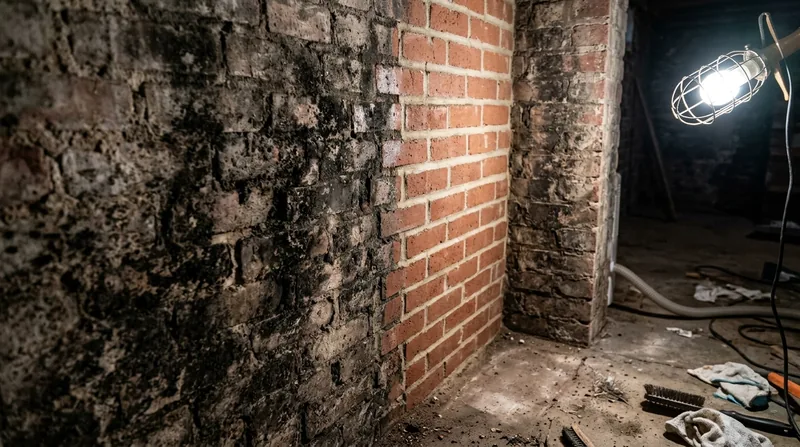




Basement Mold Remediation in Louisville starts with finding the water, not just scrubbing the wall. Our city sits on the Ohio River floodplain and on limestone and shale covered with clay soil, and that geology pushes groundwater against foundations all over Germantown, Portland, the Highlands and Clifton. Add humid summers, freeze-thaw winters and hillside runoff, and a wet basement becomes a mold problem fast. We treat the affected surfaces, contain the spores and fix the moisture source so the mold does not come back next spring. If your basement smells musty after a hard rain, that is the signal to call our free basement inspection before the growth spreads.
Why Basement Mold Remediation Matters in Louisville's Old Brick and Clay Soil
Louisville's building stock is a mold factory waiting for moisture. The 1880s-1920s brick shotguns and double-pens in Schnitzelburg and Butchertown sit on old stone or brick foundations with shallow cellars that sweat through humid summers. The 1910s-1940s Tudors and bungalows in Crescent Hill and Cherokee Triangle have full basements with cold joints and porous parging. Clay soil traps water against those walls, and the high water table in low-lying neighborhoods keeps the block wet from the outside in.
- Hydrostatic pressure pushes water through mortar joints and hairline cracks after every heavy spring rain.
- Failed drain tile and clogged footing drains let water pool at the wall base instead of draining away.
- Efflorescence and white salt staining on brick signal chronic seepage that feeds mold growth.
- Warm, humid summers keep basement relative humidity above 60 percent, which is enough for mold to colonize wood studs and drywall.
- Downspouts that dump at the foundation and grading that slopes back toward the house concentrate water exactly where you do not want it.
Every one of those conditions is fixable, and fixing the moisture is what makes remediation last.
Key info: A 1920s double-pen in Portland with a musty cellar and white efflorescence on the north wall usually has water entering at the mortar joints, not a roof leak. We find the entry point first, then treat the growth.
For official guidance on moisture and mold in homes, the U.S. EPA's mold resources at epa.gov/mold are a solid reference. For permit questions on drainage or sump discharge changes, defer to Louisville Metro's building department, because local rules vary and must be verified.
How Our Basement Mold Remediation Process Works in Louisville
We do not fog a basement and call it done. The process starts with diagnostics: a moisture meter and thermal scan of the walls, a humidity reading, and a musty smell trace to locate the source. Then we contain the work area with plastic sheeting and negative air pressure so spores do not migrate into the living space. Only after the moisture source is identified do we treat the affected materials, and we always pair remediation with the drainage or dehumidification fix that keeps the basement dry.
- We inspect the foundation, wall base and floor joint for seepage, crack activity and failed drain tile.
- We measure moisture content and relative humidity to confirm active growth versus old staining.
- We set up containment and HEPA filtration before any demolition or surface treatment begins.
- We remove porous materials that cannot be cleaned and treat structural surfaces with an antimicrobial application.
- We correct the moisture path with crack injection, interior perimeter drain, sump pump work or vapor barrier as the inspection dictates.
- We verify dryness with a final moisture reading and leave a written scope of what was treated.
That sequence matters because mold returns wherever moisture stays.
Key info: A finished basement in St. Matthews with mold behind the drywall along the floor plate usually needs the lower drywall removed, the wall base treated and an interior drain tile system installed before new drywall goes back. Skipping the drain means the same wall grows back within a season.
When the inspection shows water tracking along the footer, we route the job to our interior drain tile system crew so the moisture fix and the remediation happen as one scope.
Remediation and Moisture-Control Approaches We Use
Not every mold job in Louisville needs the same answer. A shallow cellar in Butchertown with one weeping joint is a different scope than a walkout basement in Prospect with a failed sump pump and saturated block. We match the approach to what the inspection finds, and we tell you plainly when simple sealing is enough.
| Approach | Description | Best for |
|---|---|---|
| Surface treatment with containment | HEPA vacuuming, antimicrobial application and removal of non-salvageable porous materials inside a sealed work zone. | Visible growth on joists, wall framing and stored contents after a one-time leak. |
| Crack injection plus wall sealing | Epoxy or polyurethane injection into active cracks, then a breathable sealer on the interior face to cut vapor drive. | Isolated seepage through poured or block walls with no footer water. |
| Interior perimeter drain and sump | Interior drain tile routed to a sump basin with a check valve and discharge line, plus a vapor barrier where specified. | Hydrostatic pressure and wet floor joints across the whole wall base. |
| Dehumidification and ventilation | Sized dehumidifier and controlled ventilation to hold basement humidity below the mold growth threshold. | Humid summer condensation on cold walls and pipes with no active seepage. |
| Exterior waterproofing correction | Membrane and dimple board against the wall with footing drain correction where the exterior is the only real fix. | Failed exterior coating and saturated clay soil pressing on downhill walls. |
We recommend the least invasive approach that actually stops the water, and we say so when the cheaper fix is the right one.
Basement Mold Remediation Cost in Louisville: What to Expect
Most basement mold remediation in Louisville starts around $1,500 for a contained treatment of a limited area with a straightforward moisture fix. The number moves with square footage affected, how much porous material has to come out, whether the growth is behind finished drywall, and what drainage correction the inspection calls for. A single weeping crack with surface growth sits at the low end. A finished basement with mold along an entire wall base plus a failed sump pump lands well above it.
Access is the other cost driver. Shallow cellars in Germantown and Butchertown with low headroom and stone foundations take longer to contain and treat than an open poured basement in Jeffersontown. Homes on the karst and clay ground south of the metro often need drain tile work bundled with remediation, and that scope is priced separately. Get two or three written estimates with a moisture diagnosis attached, not just a square-foot price, so you can compare what is actually included.
Our full pricing overview breaks down the ranges by scope, and we confirm the number on site before any work starts.
Choosing a Basement Mold Remediation Contractor Near Me in Louisville
Hiring for mold work near Louisville means checking three things before you sign: licensed and insured status, a written scope that names the moisture source, and references from jobs in similar housing stock. A contractor who quotes a treatment without diagnosing the water is selling you a repeat visit. Ask whether containment and HEPA filtration are included, and ask what happens if the moisture reading is still high after treatment.
- Confirm the company carries current liability insurance and workers' compensation, and ask for a certificate.
- Get the moisture diagnosis and treatment scope in writing, with the drainage correction listed separately.
- Ask for references from Louisville neighborhoods with your foundation type, whether brick, stone or poured concrete.
- Verify permits with the local building department where the scope alters drainage or sump discharge, because thresholds vary by jurisdiction.
- Check any HOA requirements before exterior work or discharge line changes, especially in newer subdivisions.
Reach us through our contact page to schedule the inspection.
Basement Mold Remediation in Louisville: Pricing Guide
| Service | Price | Details |
|---|---|---|
| Contained surface treatment | Starting at $1,500 | Includes containment, HEPA filtration, antimicrobial treatment and removal of non-salvageable materials in a limited area. |
| Remediation with crack injection | Starting at $2,200 | Adds epoxy or polyurethane injection and wall sealing where seepage enters through isolated cracks. |
| Remediation with interior drain tile | Starting at $4,500 | Bundles perimeter drain, sump basin and vapor barrier where hydrostatic pressure wets the whole wall base. |
| Finished basement tear-out | On estimate | Needs an on-site look because drywall removal, framing replacement and access drive the final scope. |
| Estimate and musty smell diagnostics | Free | Moisture readings and written scope at no charge, response within 24h at (502) 679-4421. |
Indicative pricing, the exact cost depends on square footage, finish, and site access. Free personalized estimate within 24h at (502) 679-4421.


