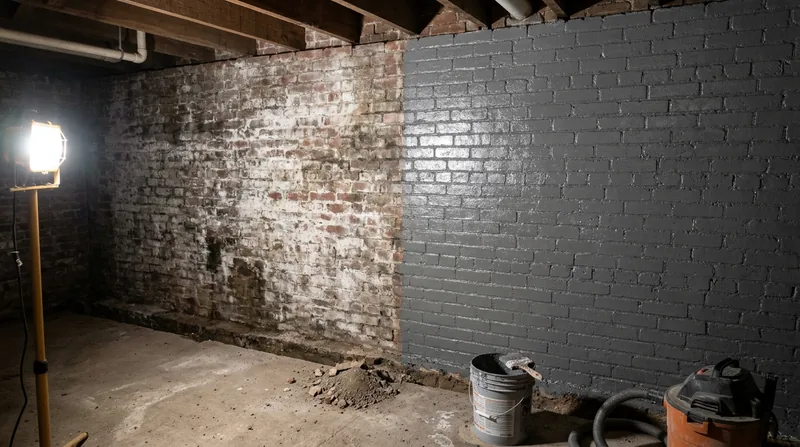




Louisville's basement water problems start below grade, where limestone and shale sit under a heavy clay cap that holds water against foundation walls long after the rain stops. In Germantown and Schnitzelburg, 1880s brick shotgun houses sit on shallow stone cellars that wick dampness up through the mortar. In the Highlands and Crescent Hill, 1920s brick Tudors and bungalows have full basements poured or block-laid before modern dampproofing existed. Out in Jeffersontown, Prospect, and Oldham County, 1990s and 2000s walkouts show seepage at the cold joint and along form-tie holes. Basement Wall Sealing in Louisville is the first line of defense for all of them, and we tell you honestly whether a sealer will fix what you have or whether the wall is under hydrostatic pressure that no coating will stop. Start with a free basement inspection and we will show you what the wall is actually doing.
Why Basement Wall Sealing Matters in Louisville's Clay and Limestone Ground
The Ohio River floodplain, the karst sinkholes south of the metro, and buried creeks like Beargrass and Mill Creek all push water toward foundations that were never built to shed it. Glacial clay soil takes water in slowly and releases it slowly, so a wall that looks dry in July can be saturated in March. Freeze-thaw winters open mortar joints and hairline cracks that seep every spring.
- Efflorescence on brick and block walls tells you water is moving through the masonry and leaving mineral salts behind.
- Damp patches and a musty basement smell after rain point to wall seepage that a penetrating sealer can slow down.
- Water pooling at the wall base or pushing the floor slab up means hydrostatic pressure, and sealing alone will not hold it.
- Old stone and brick cellars in Portland and Butchertown often need repointing and parging before any sealer will bond.
We check for all four before we quote a sealer, because putting a coating on a wall under pressure just traps water behind it.
Key info: A 1920s brick bungalow in the Highlands with white efflorescence and damp mortar is a sealing candidate. A 1950s ranch in Hikes Point with water running across the floor after a spring storm is a drain tile and sump problem, not a sealer problem. We tell you which one you have before you spend a dollar.
Louisville Metro's building department and the Kentucky Department of Housing, Buildings and Construction set the rules for structural and drainage work, and you can verify contractor licensing through the state at dhbc.ky.gov.
How We Seal Basement Walls in Louisville, Step by Step
We start by reading the wall, not by opening a bucket of sealer. That means checking moisture with a meter, mapping cracks and form-tie holes, testing efflorescence, and looking at grading and downspout discharge on the outside. Only then do we choose a penetrating sealer for damp masonry or a membrane for a wall that needs a physical barrier.
- We inspect the wall, the floor joint, and the exterior grade, and we photograph what we find.
- We remove efflorescence with a dry brush and a mild acid wash, then let the masonry dry to an acceptable moisture level.
- We route and fill active cracks with epoxy or polyurethane injection before any surface sealer goes on.
- We patch form-tie holes and honeycombed spots with hydraulic cement or a repair mortar.
- We apply the sealer in two coats, keeping the first thin enough to penetrate rather than sit on the surface.
- We extend downspouts and correct grading so the water that caused the dampness leaves the wall alone.
Every step is documented so you can see what was sealed and what was left alone on purpose.
Key info: On a 1940s block wall in St. Matthews, we injected three vertical cracks, parged a soft mortar joint, and applied a breathable membrane. The homeowner had been quoted a full exterior dig by another company. The wall was damp, not bowing, and sealing plus grading solved it for a fraction of the cost. For homes in St. Matthews (40207), we can usually tell from the driveway whether the wall needs a sealer or a drain.
Sealing Approaches We Use and When Each One Fits
No single product works on every Louisville wall. Brick, block, poured concrete, and old stone each behave differently, and a sealer that works on a 2005 poured wall in Prospect can trap moisture in an 1890s brick cellar in Portland.
| Approach | Description | Best for |
|---|---|---|
| Penetrating sealer | Sinks into masonry pores and reacts to block water vapor while slowing liquid water. | Damp brick and block walls with efflorescence but no standing water. |
| Cementitious membrane | Troweled or sprayed coating that builds a physical barrier on the interior face. | Poured concrete walls with form-tie holes and minor seepage. |
| Crack injection | Epoxy for structural cracks, polyurethane for active leaks, injected through ports. | Vertical and diagonal cracks that are letting water in now. |
| Parging and repointing | Replacing soft or eroded mortar before sealing so the sealer has a sound base. | Old stone and brick cellars in Germantown and Butchertown. |
| Interior drain tile | Perimeter drain and sump basin that relieve hydrostatic pressure at the footing. | Walls where water comes through the floor joint no matter how they are sealed. |
If the table points to drain tile rather than sealer, we say so and walk you through the interior drain tile system instead of selling you a coating that will fail.
Basement Wall Sealing Cost in Louisville: What to Expect
Most basement wall sealing jobs in Louisville start around $1,500 for a single wall or a small cellar with minor dampness and no active leaks. From there the price moves with square footage, wall condition, and how much prep the masonry needs before a sealer can go on. A full basement with crack injection, efflorescence removal, and two coats runs higher, and a wall that needs parging or repointing first is a different job.
- Wall length and height drive material and labor more than any other factor.
- Active cracks add injection work, and polyurethane costs more than a simple surface fill.
- Old stone and soft brick need repointing before sealing, which is skilled hand work.
- Access matters: a finished basement with paneling and shelving takes longer to protect and work around.
- Exterior grading and downspout corrections are often quoted alongside sealing because they keep the wall dry.
Get two or three written estimates and compare scope, not just the bottom line, because a cheap sealer on a wall that needs injection is money thrown away. Our full pricing overview breaks down the ranges.
Finding a Basement Wall Sealing Contractor Near Me in Louisville
You want a contractor who will tell you when sealing is not the answer. Ask for proof of licensing and insurance, ask how they test for moisture before quoting, and ask what they do if the wall turns out to be under hydrostatic pressure. A company that only sells coatings will sell you a coating.
- Confirm the contractor is licensed and insured, and ask for a certificate of insurance before work starts.
- Get at least three estimates and make sure each one lists prep, materials, and crack treatment separately.
- Ask for local references from Louisville neighborhoods with housing stock like yours.
- Ask whether the work needs a permit from Louisville Metro, since structural and drainage changes often do.
- Check HOA rules in subdivisions in Prospect or Jeffersontown before any exterior grading changes.
We are happy to walk you through all of it, and you can contact us to set up a free inspection with no pressure to book.
Basement Wall Sealing in Louisville: Pricing Guide
| Service | Price | Details |
|---|---|---|
| Single wall sealing | Starting at $1,500 | Includes moisture testing, efflorescence removal, and two coats of penetrating sealer on one wall. |
| Full basement sealing | Starting at $2,800 | Covers all accessible walls, with crack injection and form-tie patching priced as needed. |
| Crack injection add-on | Starting at $450 | Epoxy or polyurethane injection per crack, with active leaks costing more than dry structural cracks. |
| Parging and repointing | On estimate | Old stone and soft brick need an on-site look before we quote mortar repair and sealing. |
| Travel | Included | In Louisville and surrounding areas, no separate call-out or mileage fee. |
| Estimate | Free | Response within 24h at (502) 679-4421, no obligation to book. |
Indicative pricing, the exact cost depends on square footage, finish, and site access. Free personalized estimate within 24h at (502) 679-4421.


