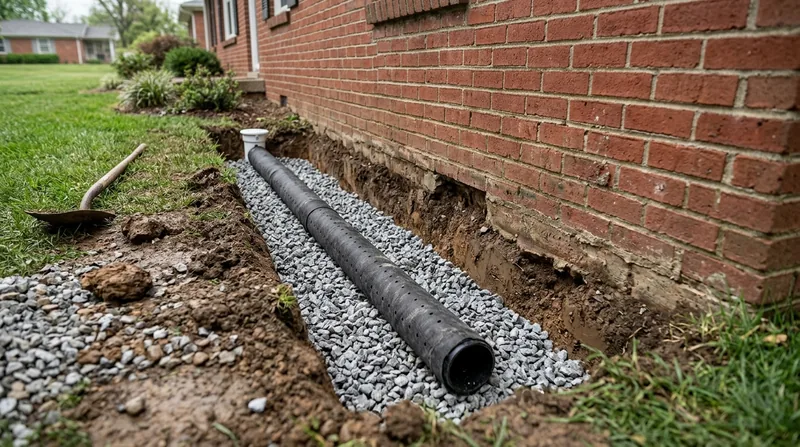




French Drain Installation in Louisville: Stop Groundwater Before It Reaches Your Foundation
Louisville sits on the Ohio River floodplain and on limestone and shale layered with glacial clay soil, and that geology decides where water goes when it rains. In Germantown, Schnitzelburg, and Portland, 1880s to 1920s brick shotgun houses and double-pens sit on old stone and brick foundations with shallow cellars that take on water fast. Uphill from those neighborhoods, the Highlands, Cherokee Triangle, and Crescent Hill hold 1910s to 1940s Tudors and bungalows with full basements cut into sloping lots, and runoff from the ridge line arrives against the downhill wall with nowhere to go. Across St. Matthews, Beechmont, Hikes Point, and Okolona, 1950s and 1960s brick ranches with partly finished basements fight the same hydrostatic pressure every spring. French Drain Installation in Louisville intercepts that groundwater along the foundation wall and carries it away before it can push through the wall or pool at the footing. We install exterior gravel and pipe systems with fabric wrap, tied to daylight or to a sump basin, and we tell you plainly when a simpler repair is enough. If your basement already takes water, start with a free basement inspection so we can trace where it enters.
Why Louisville Lots Need a Drain Along the Foundation Wall
Most wet basements here are not a wall problem, they are a drainage problem. Clay soil holds water instead of letting it percolate, the water table in low-lying neighborhoods stays high through spring, and buried creeks like Beargrass and Mill Creek still influence where groundwater collects. When that water reaches the footing, hydrostatic pressure builds against the wall and finds every cold joint, tie hole, and hairline crack. A proper perimeter drain gives it a path of least resistance that leads away from the house.
- Hillside lots in Prospect, Anchorage, and Crestwood collect runoff from uphill and deliver it straight to the downhill foundation wall.
- Old stone and brick foundations in Butchertown and Portland have no footing drain at all, so water sits against the masonry until it seeps through.
- 1950s ranches in Okolona and Hikes Point often have a collapsed or clay-clogged original footing drain that stopped working decades ago.
- Subdivision homes in Jeffersontown and Fern Creek with walkout basements need the uphill side drained or the lower wall stays wet.
If you see efflorescence, a musty basement smell, or wall seepage after every heavy rain, the drain is the first thing we check before anyone talks about sealing the inside of the wall.
Key info: A 1920s brick double-pen in Schnitzelburg with a shallow cellar and a dirt floor along the wall usually needs an exterior drain plus a sump basin, not just crack sealing. On a 1960s ranch in St. Matthews with a finished basement, the same symptom often traces to a failed original footing drain that a new perimeter system replaces.
For the official rules on drainage work and discharge connections, check the Louisville Metro Codes and Regulations before work starts, because requirements vary by jurisdiction and have to be verified.
How We Install a French Drain on a Louisville Foundation
We start by finding where the water actually comes from, not by digging a trench where it is convenient. On a sloped lot in the Highlands or Clifton, that means walking the grade above the house and watching the downspout and grading pattern, because surface runoff and groundwater need different answers. On a flat lot in Shively or Lyndon, the water table and the soil tell the story. Then we set the line of the drain, the depth, and the discharge point before any gravel moves.
- We excavate along the exterior foundation wall to the footing, by hand near utilities and in tight side yards.
- We clean and inspect the wall, then address cracks and joints before backfill goes back in.
- We lay washed gravel, set perforated pipe at the correct fall, and wrap the assembly in filter fabric so clay soil cannot clog it.
- We tie the drain to daylight on a slope, or to a sump basin and pump where gravity will not carry the water.
- We extend discharge lines and correct grading and downspout extensions so roof water stops landing at the wall.
- We backfill in lifts, compact, and restore the surface so the yard drains away from the house.
Every system we install comes with a transferable warranty, and we explain exactly what it covers before you sign anything.
Key info: On a 1930s Tudor in Crescent Hill, the uphill side of the house had a shallow footing and a side yard too narrow for equipment. We hand-dug the trench, set the pipe at a fall toward a daylight outlet at the curb line, and wrapped the gravel in fabric so the clay soil would not silt it in. The basement stayed dry through the next spring's heavy rain.
When the exterior route is impractical, an interior drain tile system is often the better answer, and we will say so instead of selling you an excavation you do not need.
Exterior Drain Approaches We Use in Louisville
| Approach | Description | Best for |
|---|---|---|
| Exterior footing drain to daylight | Gravel and perforated pipe along the footing, fabric-wrapped, discharging by gravity to a lower grade point. | Sloped lots in Prospect, Anchorage, and Crestwood where grade drops away from the house. |
| Exterior drain to sump basin | Same perimeter drain, but the water collects in a sump basin and is pumped out through a discharge line. | Flat lots in Shively, Lyndon, and St. Matthews where gravity will not carry water away. |
| Curtain drain uphill | A drain set into the slope above the house to intercept hillside runoff before it reaches the foundation wall. | Hillside homes in the Highlands and Clifton with water arriving from the ridge. |
| Drain tile replacement | Removing a collapsed clay or failed original footing drain and installing a new fabric-wrapped system in its place. | 1950s and 1960s ranches in Beechmont, Hikes Point, and Okolona with a dead original drain. |
French Drain Installation Cost in Louisville: What to Expect
Pricing for a French drain runs by the linear foot because the work is trenching, gravel, pipe, fabric, and discharge, and the length of wall that needs protection drives the number. Our starting point is from $25 per linear foot, and that figure moves with depth, access, soil, and where the water has to go. A straight run along an open side yard in Jeffersontown costs less per foot than a hand-dug trench in a narrow Highlands side yard with a shallow footing and utilities in the way. Discharge matters too: a daylight outlet on a slope is simpler than a sump basin and pump on a flat lot.
Depth is the biggest variable. A drain set at a shallow footing in a 1920s Portland cellar is a shorter dig than a full-depth perimeter system around a 1990s walkout in Prospect. Soil conditions add cost in the karst areas south of the metro, where limestone and sinkholes can change the plan once we open the ground. Access adds cost when the trench has to be dug by hand, and restoration adds cost when a finished patio or established planting sits over the line.
Get two or three estimates and compare scope, not just the bottom line. Ask each contractor how deep the drain goes, what the discharge point is, whether the price includes restoration, and what the warranty covers. A cheap per-foot number that stops at the trench and leaves you to handle the discharge line is not the same job. Our full pricing overview breaks down what sits behind the per-foot figure.
Finding a French Drain Contractor Near Me in Louisville
Hiring for drainage work near Louisville comes down to verifying a few things before anyone digs. Ask for the license and insurance certificate and confirm the coverage is current, because a contractor working below grade without coverage leaves you exposed if a utility line or a wall is damaged. Get at least three written estimates with the same scope so you can compare them honestly, and ask for references from jobs in your part of the metro, since a contractor who knows old stone foundations in Germantown may not know the walkout lots in Prospect.
Ask who pulls the permit. Work that alters drainage or connects a sump discharge to the sanitary system commonly requires a permit, and the rules vary by jurisdiction, so confirm with the local building department rather than taking a verbal assurance. In older neighborhoods, check whether your property sits in a historic district with its own review requirements before excavation begins. If you are in an HOA, read the covenants on drainage changes and discharge points before work starts.
Finally, ask what happens after the job. A transferable warranty, a clear description of the discharge point, and a written scope are the marks of a contractor who expects the system to keep working. You can reach us through our contact page to schedule an inspection and get a straight answer on whether a French drain is the right fix for your basement.
French Drain Installation in Louisville: Pricing Guide
| Service | Price | Details |
|---|---|---|
| Exterior French drain to daylight | Starting at $25/linear ft | Includes excavation, washed gravel, perforated pipe, filter fabric, and gravity discharge to a lower grade point. |
| Exterior drain tied to sump basin | Starting at $35/linear ft | Adds a sump basin, pump, check valve, and discharge line for flat lots where gravity will not carry water. |
| Curtain drain on a hillside lot | On estimate | Slope length, depth, and outlet location vary too much to price before an on-site look at the grade. |
| Drain tile replacement | On estimate | Removing a failed original footing drain and restoring the wall and surface needs an inspection first. |
| Travel | Included | In Louisville and surrounding areas, no separate call-out or mileage fee. |
| Estimate | Free | Response within 24h at (502) 679-4421, no obligation to book. |
Indicative pricing, the exact cost depends on square footage, finish, and site access. Free personalized estimate within 24h at (502) 679-4421.


