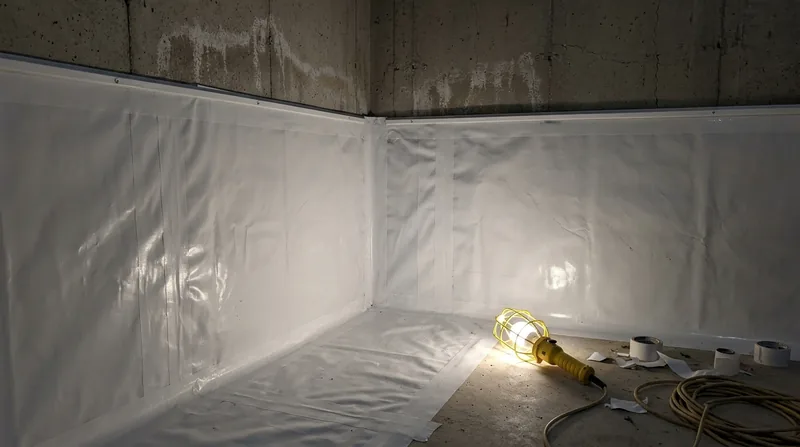




Louisville sits on the Ohio River floodplain where limestone and shale meet glacial clay soil, and that geology drives everything about basement moisture here. In Germantown and Schnitzelburg, 1880s brick shotgun houses sit on shallow stone foundations that wick ground vapor straight into the lower level. In the Highlands and Crescent Hill, 1910s brick Tudors and bungalows have full basements where efflorescence blooms on the walls every spring. Out in Jeffersontown and Prospect, 1980s to 2010s poured-concrete basements collect humid air that never quite leaves. Vapor Barrier Installation in Louisville blocks that ground moisture vapor at the wall and slab before it ever reaches your living space. We install heavy-duty barrier sheets with sealed seams, taped terminations, and sump integration where the floor needs it. This is below-grade work, and it belongs to a specialist, not a general handyman. Start with a free basement inspection so we can read what your foundation is actually doing.
Why Vapor Barrier Installation Matters in Louisville's Clay and Limestone Basements
Ground moisture vapor moves through concrete and brick mortar no matter how dry the floor looks. Louisville's high water table in low-lying neighborhoods like Portland and Butchertown keeps that vapor pressure constant, and the freeze-thaw cycle every winter opens hairline paths through old mortar joints. When vapor condenses on cool basement walls, you get the musty smell and the white efflorescence crust that so many homeowners here mistake for a leak. A proper barrier stops the vapor at the source instead of letting it migrate into finished space.
- Old stone and brick foundations in Germantown and Portland pull vapor through mortar joints that no paint or sealer can hold back long term.
- Poured-concrete walkout basements in Prospect and Fern Creek have cold wall surfaces where humid summer air condenses into visible dampness.
- Homes near buried creeks like Beargrass and Mill Creek sit on saturated ground where vapor pressure stays high even in dry weeks.
- Partially finished basements in St. Matthews and Hikes Point trap moisture behind paneling and carpet, which is where mold growth starts.
Every one of those failure modes is a moisture control problem first, and a barrier is the first line of defense.
Key info: A homeowner in Clifton called us about a musty smell that appeared every April in a finished basement room. The walls were dry to the touch, but a plastic sheet taped to the concrete for 24 hours came back soaked on the underside. That is vapor, not a leak, and a sealed barrier fixed it without touching the drain tile.
For official guidance on basement moisture and foundation drainage, the Louisville Metro Government portal is a useful starting point for local permit and code questions.
How We Install Vapor Barriers in Louisville Basements
We start by mapping where the moisture is actually coming from, because a barrier installed over an active hydrostatic pressure problem just traps water behind plastic. Our crew checks wall readings, slab moisture, and the condition of the existing drain tile and sump basin before we cut a single sheet. Then we install heavy-duty barrier material tight to the wall and continuous across the slab, with every seam overlapped and sealed. Terminations get taped and mechanically fastened so the barrier stays put through seasonal movement.
- We inspect the basement perimeter, slab, and sump basin to confirm the barrier is the right fix and not a cover-up.
- We clear the walls, remove loose parging, and address any active crack with epoxy or polyurethane injection first.
- We hang or adhere the barrier sheet with a consistent overlap and seal every seam with compatible tape.
- We integrate the barrier into the sump basin and discharge line so water that reaches the floor still drains.
- We tape and fasten all terminations, then walk the job with you and show you the sealed edges.
If the inspection shows a failing perimeter drain, we tell you before we install anything, because the barrier is only as good as the drainage under it. You can read more about that diagnostic step on our interior drain tile system page.
Key info: A 1950s brick ranch in Okolona had a sump pump that ran constantly after spring rain. We found the basin was fine but the slab was wicking vapor into a finished room. We sealed the barrier to the basin lip and taped the wall termination, and the room stayed dry through the next wet season without a pump replacement.
Vapor Barrier Approaches We Use in Louisville Homes
Not every basement gets the same barrier detail. Old stone foundations in Butchertown need a different termination strategy than a poured walkout in Anchorage, and a slab with an active sump needs integration that a dry slab does not. Here is how we match the approach to the building.
| Approach | Description | Best for |
|---|---|---|
| Wall-hung barrier | Heavy sheet fastened to the wall with sealed seams and taped top termination. | Full basements with damp brick or block walls and no active seepage. |
| Slab barrier with sump integration | Continuous sheet across the floor, sealed to the sump basin lip and discharge line. | Basements where the slab wicks vapor and a sump pump already runs. |
| Dimple board drainage mat | Drainage mat behind the barrier that channels wall moisture down to the perimeter drain. | Hillside homes with runoff pressure against a downhill wall. |
| Barrier over crack-repaired walls | Injection ports and epoxy or polyurethane repair completed before the sheet goes up. | Walls with visible cracks and efflorescence that need sealing and vapor control. |
| Exterior membrane pairing | Below-grade waterproof membrane on the outside with interior vapor control inside. | New construction and major exterior excavation projects. |
We pick the approach after the inspection, not before, because the wrong barrier detail wastes money and hides the real problem.
Vapor Barrier Installation Cost in Louisville: What to Expect
Most residential vapor barrier work in Louisville starts from $3 per square foot of covered wall and slab area, and that figure moves with the job. A simple wall-hung barrier in a dry 1950s ranch in Beechmont sits near the low end. A full slab and wall system with sump integration in a finished walkout in Prospect sits higher because of prep, seam count, and the care needed around finished surfaces. Old stone foundations in Portland take more labor because the walls are uneven and need extra fastening.
Access matters too. A basement with a finished ceiling, built-in shelving, or a tight stairwell takes longer than an open one. If we find active hydrostatic pressure or a failing drain tile, that repair has to happen before the barrier, and we price it separately so you can see exactly what each part costs. Getting two or three estimates is smart, and so is asking each contractor whether the price includes crack repair and sump integration or leaves it out.
Our full pricing overview breaks down the ranges by scope so you can compare apples to apples before anyone walks your basement.
Vapor Barrier Installation Near Me: How to Vet a Louisville Contractor
When you search for vapor barrier installation near me, the list you get is mostly whoever ranks, not whoever is right for an old Louisville foundation. Ask for the license and insurance certificate before the estimate, not after. Ask how many basements like yours they have done in Germantown or St. Matthews, because a contractor who only works new poured concrete will misread a stone foundation. Ask for two recent references and actually call them.
Permits are commonly required when work alters drainage or the sanitary connection of a sump discharge, and the thresholds vary by jurisdiction, so confirm with the local building department before work starts. If your home is in a historic district, exterior changes may need review as well. We walk you through what applies to your address and put the scope in writing.
Reach out through our contact page to schedule a free inspection and get a written scope before you commit to anything.
Vapor Barrier Installation in Louisville: Pricing Guide
| Service | Price | Details |
|---|---|---|
| Wall-hung vapor barrier | Starting at $3/sq ft | Includes wall prep, heavy sheet, sealed seams, and taped top termination for damp basement walls. |
| Slab barrier with sump integration | Starting at $4/sq ft | Covers floor sheet, basin lip seal, and discharge line integration where a sump pump runs. |
| Barrier plus crack repair | On estimate | Injection repair of active cracks is priced after inspection because crack count and width vary. |
| Dimple board drainage mat | Starting at $5/sq ft | Adds a drainage mat behind the barrier for hillside homes with runoff pressure. |
| Travel | Included | in Louisville and surrounding areas, no separate call-out or mileage fee |
| Estimate | Free | Response within 24h at (502) 679-4421, no obligation to book |
Indicative pricing, the exact cost depends on square footage, finish, and site access. Free personalized estimate within 24h at (502) 679-4421.


