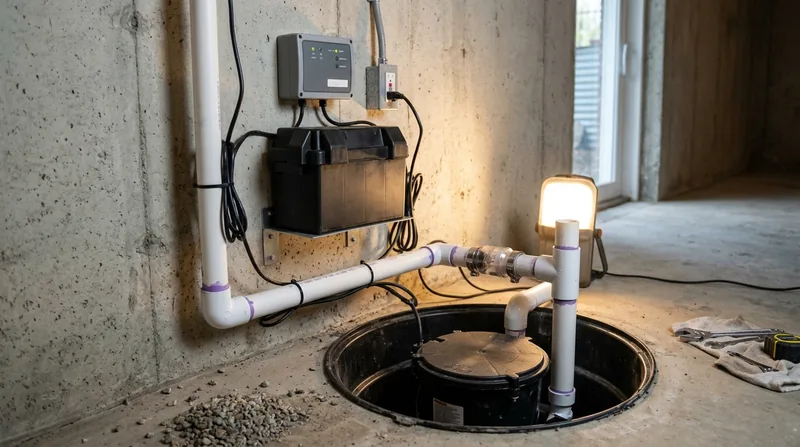




Battery Backup Sump Pumps in Louisville: Keep the Basin Dry When the Grid Goes Down
Louisville sits on the Ohio River floodplain over limestone and shale, with clay soil and a water table that climbs fast in spring. A thunderstorm that knocks out power in St. Matthews or Crescent Hill is exactly the moment your primary sump pump stops. Battery Backup Sump Pumps in Louisville keep the basin emptying when the lights go out, so a wet basement does not turn into a flooded one. We size the backup to your existing sump basin and discharge line, wire it correctly, and test it before we leave. If you are still running a single pump with no backup, that is the gap we close first. Start with a sump pump installation and replacement review if the primary pump is already aging.
Why Louisville Basements Need a Backup Pump, Not Just a Primary
The dominant failure here is not a dead pump motor, it is a dead circuit. Heavy spring rain pushes hydrostatic pressure against old stone and brick foundations in Germantown, Schnitzelburg, and Portland, and the same storm that floods the footing drain is the one that takes out the power. In the 1910s to 1940s full basements of the Highlands and Clifton, and the 1950s ranches of Hikes Point and Okolona, the sump pump runs for hours during a rain event. A backup battery carries that load when the primary cannot.
- We check the sump basin size and the float switch height before matching a backup unit.
- We confirm the check valve and discharge line can handle a second pump without backflow.
- We test the battery under load so you know the runtime, not just the label rating.
- We add a high-water alarm when the basin has no visible warning of a rising water line.
That combination is what separates a real backup from a box on a shelf.
Key info: In low-lying pockets of Shively and along the Mill Creek corridor, we routinely see sump basins fill faster than a single pump can clear during a summer downpour. A backup with a float-triggered second pump buys the runtime that matters.
For the code side, verify sump discharge and drainage requirements with the Louisville Metro Codes and Regulations before any discharge line is altered.
How We Install a Battery Backup Sump Pump in Louisville
We start at the basin, not at the catalog. The pit depth, the incoming drain tile, and the existing discharge tell us which backup fits and where the battery box can sit above the water line. From there we mount, wire, and test under a simulated outage so you see the backup take over before we pack up.
- We inspect the sump basin, float, check valve, and discharge line for condition and capacity.
- We size the backup pump and battery to the pit volume and the expected runoff from your footing drain.
- We install the backup pump on its own float, separate from the primary, so one failure does not disable both.
- We wire the charger and alarm to a dedicated circuit and label the breaker.
- We run a live test, confirm runtime, and show you the alarm and reset procedure.
Every install ends with a working demonstration, not a verbal promise.
Key info: A Prospect walkout basement on a hillside had a primary pump that ran 40 minutes per storm cycle. We added a backup sized for two hours of runtime and a high-water alarm, and the homeowner could see the basin level from the stair landing. That is the kind of margin a hillside lot needs.
If the basin itself is undersized or the drain tile is silted, a backup alone will not fix the inflow. In that case we look at an interior drain tile system before adding hardware.
Backup Pump Approaches We Use in Louisville
Not every basement needs the same hardware. We match the approach to the pit, the power situation, and how long the pump actually runs during a storm. The table below shows the options we install most often in the Louisville metro.
| Approach | Description | Best for |
|---|---|---|
| Battery backup pump | Secondary pump on its own float with a rechargeable battery and charger. | Most homes with an existing sump basin and occasional outages. |
| Combination primary and backup unit | One housing with a primary pump and a battery-driven backup pump. | Aging primary pump in a basin that is already correctly sized. |
| Backup with high-water alarm | Backup pump plus an audible alarm that triggers before the basin overflows. | Finished basements and homes where the basin is out of sight. |
| Extended runtime battery bank | Larger battery capacity for longer outages and high-inflow pits. | Low-lying lots and hillside runoff against downhill walls. |
We will tell you plainly when a standard backup is enough and when the pit needs more capacity.
Battery Backup Sump Pumps Cost in Louisville: What to Expect
Most battery backup installations in the Louisville market start around $900, and that figure covers a standard backup pump, a battery, a charger, and the labor to mount and test it. The number moves when the pit is deep, when the discharge line needs rework, or when you choose an extended runtime battery bank for a low-lying lot.
- Basin depth and condition affect how much mounting and plumbing work is needed.
- Battery capacity drives the price more than the pump itself on most jobs.
- Adding a high-water alarm or a combination primary and backup unit changes the scope.
- Access matters in tight cellars under old shotgun houses where the pit sits behind the stairs.
Get two or three estimates and compare what is actually included, not just the bottom line. Our full pricing overview shows how the line items break down.
Battery Backup Sump Pumps Near Me: How to Vet a Louisville Contractor
When you search for battery backup sump pumps near me, the list you get is mostly whoever paid for the ad. The vetting is on you, and it takes about ten minutes per call.
- Confirm the contractor is licensed and insured and can send a certificate on request.
- Get at least two written estimates that itemize pump, battery, charger, and labor separately.
- Ask whether the work needs a permit and who pulls it, since discharge and drainage changes can trigger one.
- Check references from jobs in your part of town, not just a generic list.
If a contractor will not put the scope in writing, keep calling. You can reach us through the contact page to schedule a free basement inspection and get a written scope before any work begins.
Battery Backup Sump Pumps in Louisville: Pricing Guide
| Service | Price | Details |
|---|---|---|
| Standard battery backup pump install | Starting at $900 | Includes backup pump, battery, charger, mounting, wiring, and a live runtime test. |
| Combination primary and backup unit | Starting at $1,250 | Single housing with primary and battery backup, sized to an existing correctly built basin. |
| Extended runtime battery bank | Starting at $1,450 | Larger battery capacity for long outages and high-inflow pits on low-lying lots. |
| High-water alarm add-on | Starting at $175 | Audible alarm that triggers before the basin overflows, wired to a dedicated circuit. |
| Complex or large-scale job | On estimate | Deep pits, discharge rework, or tight cellar access need an on-site look before pricing. |
| Estimate | Free | Response within 24h at (502) 679-4421, no obligation to book. |
Indicative pricing, the exact cost depends on square footage, finish, and site access. Free personalized estimate within 24h at (502) 679-4421.


