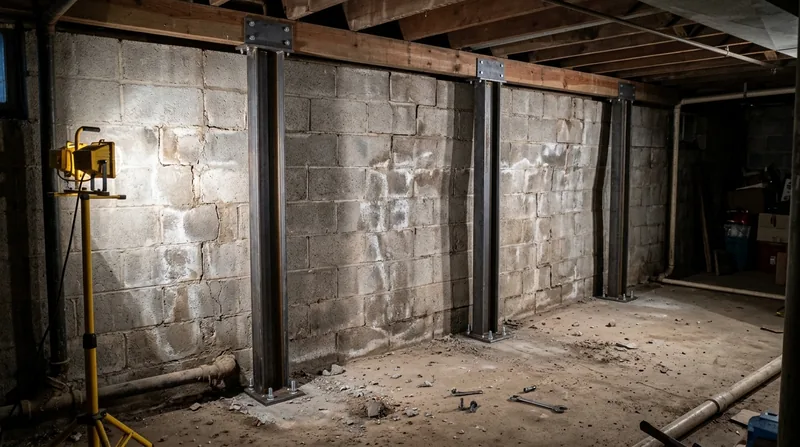




Louisville sits on the Ohio River floodplain over limestone and shale, and much of the metro rests on expansive glacial clay soil that swells hard every spring. When that saturated clay presses against a block or stone basement wall in Germantown, Portland, or the Highlands, the wall has nowhere to go but inward. Bowing Wall Repair in Louisville is the work of stopping that movement before the wall fails, using carbon fiber straps, steel I-beams, or wall anchors matched to how far the wall has moved and what your soil is doing. If you are still diagnosing where the water is coming from, start with our basement waterproofing service page and then come back to the wall itself.
Why Bowing Walls Are a Louisville Problem, Not a Cosmetic One
Older brick and block walls in Schnitzelburg, Butchertown, and Clifton were laid with shallow footings and lime mortar, and they were never designed for the hydrostatic pressure a wet clay hillside can build. A wall that leans a half inch over ten feet is a warning; a wall that leans two inches and has a horizontal crack at mid-height is a structural call. In the 1950s brick ranches around Hikes Point and Okolona, we see the same pattern on poured walls where the footing drain has silted shut and the water table rises fast after a heavy spring storm.
- Saturated clay soil pushes inward with hydrostatic pressure that no paint or sealer can hold back.
- Failed or clogged footing drains let water sit against the wall all season instead of draining away.
- Freeze-thaw cycles open existing cracks and let water refreeze behind the wall face.
- Downspouts dumping at the foundation and flat grading concentrate runoff right at the wall base.
- Old stone and brick foundations in Portland and Shively often have no drain tile at all.
The fix is structural first and waterproofing second, and we sequence it that way so the wall stops moving before we address the water driving it.
Key info: A bowing wall in the Highlands after the spring thaw is usually a drainage failure that has been building for years, not a sudden event. The wall moved because water sat against it, and it will keep moving until that water is redirected.
For the code side, structural foundation repair permits in Louisville are handled through the local building department, and rules vary by jurisdiction, so verify the current requirement before any work starts. You can check the Louisville Metro Government site for the applicable office.
How We Diagnose and Stabilize a Bowing Wall in Louisville
We start by measuring the wall, not guessing at it. A plumb line and a level tell us how far the wall has moved, and a look at the mortar joints, the footing, and the soil tells us why. Then we match the repair to the severity: carbon fiber straps for walls that have bowed but not displaced at the top, steel I-beams for walls that need real bearing capacity, and wall anchors for walls that are moving outward at the top and need to be pulled back.
- We measure the deflection along the full wall and photograph the cracks and mortar joints.
- We check the footing drain, the grading, and the downspouts to find what is feeding the pressure.
- We recommend the method that matches the movement, and we tell you when a simpler repair is enough.
- We install the system, whether that is carbon fiber straps, steel I-beams, or wall anchors, and we torque and verify it.
- We correct the water source with drainage so the wall is not fighting the same pressure next spring.
Every job ends with a written record of the deflection measurements so you can see what changed and what to watch.
Key info: On a 1920s double-pen in Germantown with a stone foundation, we found the wall had bowed because the original footing drain had collapsed under the sidewalk. We stabilized the wall with steel I-beams and rebuilt the drainage, and the wall has held its line through two spring seasons.
If the wall is moving because water is pooling at the base, the drainage side of the job matters as much as the steel. Our interior drain tile system page covers how we relieve that pressure from inside without excavating the yard.
Repair Methods We Match to Louisville Wall Conditions
No single method fits every wall. A poured wall in Jeffersontown that has bowed an inch behaves differently from a rubble stone wall in Portland that has been leaning for decades, and the repair has to reflect that. This table shows how we match the approach to the wall and the soil.
| Approach | Description | Best for |
|---|---|---|
| Carbon fiber straps | High-strength straps bonded vertically to the wall and anchored at the footing and sill. | Block and poured walls with moderate bowing and no top displacement. |
| Steel I-beams | Vertical steel beams set against the wall and tied into the floor and footing. | Walls with significant deflection that need bearing capacity. |
| Wall anchors | Plates on the inside tied to anchors driven into stable soil outside. | Walls moving outward at the top, common on hillside lots. |
| Drainage correction | Footing drain repair, grading, and downspout extension to relieve pressure. | Any wall where water is the driving force behind the movement. |
Bowing Wall Repair Cost in Louisville: What to Expect
Most homeowners want a number before they want a lecture, so here is the honest shape of it. Simple stabilization work and drainage corrections start from $600, and a full structural repair on a badly bowed wall runs higher because the method, the wall length, and the access all change the labor. The factors that move the price most are the repair method, how far the wall has moved, the wall material, and whether the drainage has to be rebuilt at the same time.
- The repair method drives most of the cost, since carbon fiber straps and steel I-beams are different jobs.
- Wall length and height change the material count and the labor hours.
- Access matters: a wall behind a finished basement or under a porch takes more setup.
- Drainage correction adds cost but is often what keeps the wall from moving again.
- Emergency stabilization after a storm carries a premium over scheduled work.
Get two or three estimates and compare the method, not just the number, because a cheap strap job on a wall that needs beams is money wasted. Our full pricing overview breaks down the line items so you can see what each option includes.
Bowing Wall Repair Near Me: How to Choose a Contractor Near Louisville
When you search for bowing wall repair near me, you get a mix of general foundation firms, plumbers, and dedicated below-grade specialists. Ask each one what method they propose and why, and make sure the answer references your wall's actual deflection, not a generic package. Licensed and insured status is the first filter, and a certificate of insurance should be available on request.
- Confirm the contractor is licensed and insured for structural foundation work in Kentucky.
- Get at least three written estimates that name the repair method and the measurements behind it.
- Ask for local references on walls of similar age and material, and call them.
- Ask who pulls the permit, since structural foundation repair commonly requires one and rules vary by jurisdiction.
- Check any HOA or historic-district requirements before work begins, especially in older Louisville neighborhoods.
A contractor who measures the wall and explains the drainage side is the one worth hiring. You can reach us through our contact page to set up a free inspection.
Bowing Wall Repair in Louisville: Pricing Guide
| Service | Price | Details |
|---|---|---|
| Carbon fiber strap stabilization | Starting at $600 | Covers measurement, strap layout, and bonding on a moderate bow with no top displacement. |
| Steel I-beam wall stabilization | Starting at $1,800 | Includes beam set, floor and footing tie-in, priced by wall length and deflection. |
| Wall anchor system | Starting at $2,400 | Inside plates and outside earth anchors, priced by anchor count and soil access. |
| Drainage correction add-on | Starting at $900 | Footing drain repair, grading, and downspout extension to relieve hydrostatic pressure. |
| Complex or large-scale job | On estimate | Multi-wall movement, finished basements, or hillside lots need an on-site look first. |
| Estimate | Free | Response within 24h at (502) 679-4421, no obligation to book. |
Indicative pricing, the exact cost depends on square footage, finish, and site access. Free personalized estimate within 24h at (502) 679-4421.


